
Rethinking Digital Transition: new challenges and old issues
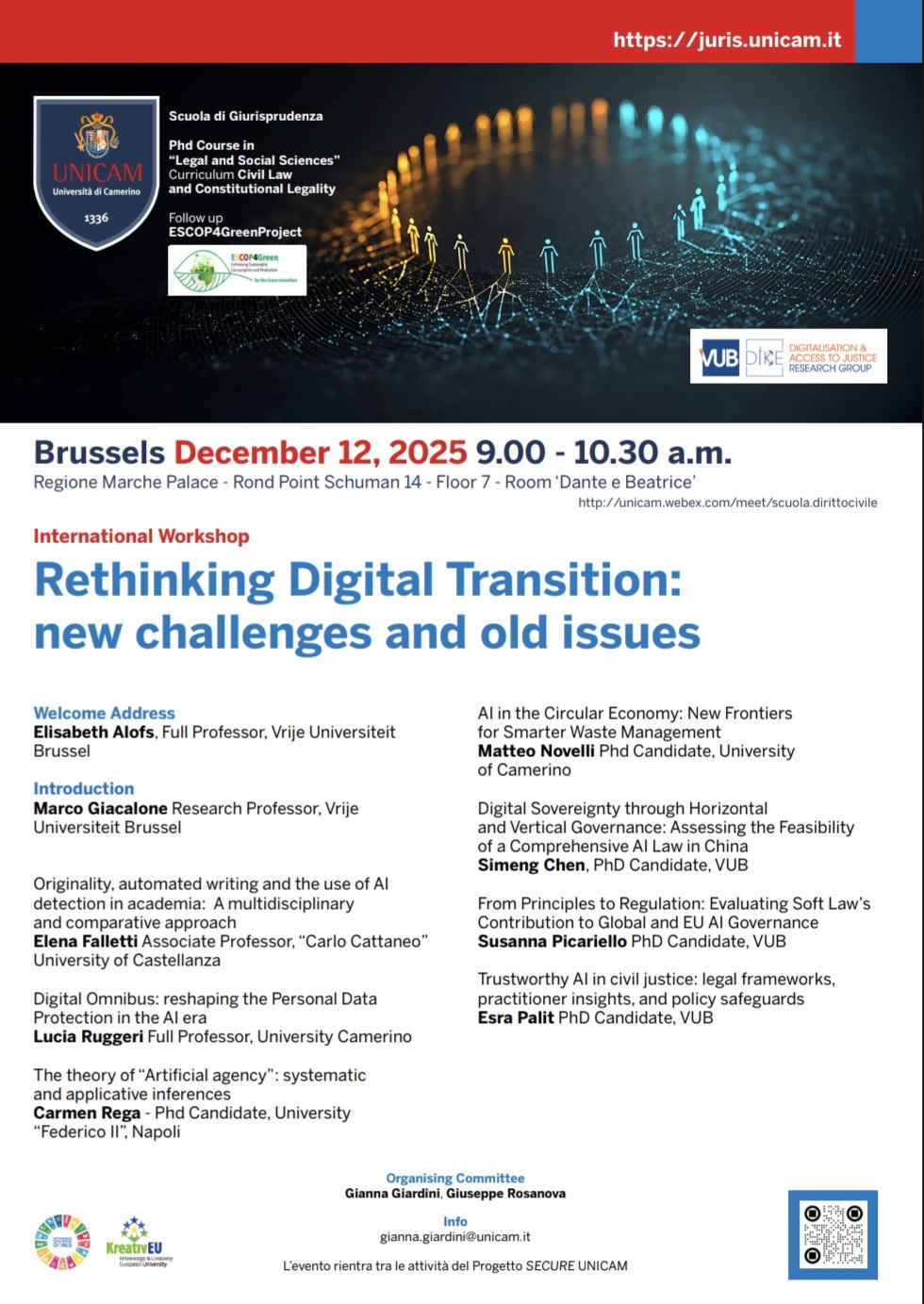
The international workshop “Rethinking Digital Transition: New Challenges and Old Issues”, held on 12 December 2025 at the Regione Marche Palace in Brussels, brought together academics, researchers, and legal scholars to examine the evolving relationship between digital transformation, artificial intelligence, governance, and fundamental rights. 

Organized within the activities of the SECURE Project and in collaboration with the Digitalisation & Access to Justice Research Group of Vrije Universiteit Brussel (VUB), the workshop provided an interdisciplinary forum for discussing both emerging opportunities and longstanding challenges arising from the digital transition.

The event opened with a welcome address by Elisabeth Alofs, Full Professor at Vrije Universiteit Brussel, followed by introductory remarks from Marco Giacalone, Research Professor at VUB. 

The discussions explored a wide range of topics related to artificial intelligence, digital governance, data protection, academic integrity, access to justice, and sustainability.

Among the speakers, Elena Falletti (Carlo Cattaneo University of Castellanza) examined originality, automated writing, and the use of AI-detection tools in academia from a multidisciplinary and comparative perspective. 

Lucia Ruggeri (University of Camerino) discussed the implications of the Digital Omnibus framework for personal data protection in the age of artificial intelligence. 

Carmen Rega (University of Naples Federico II) presented research on the theory of “artificial agency” and its systematic and practical applications.

Matteo Novelli (University of Camerino) explored the role of artificial intelligence in the circular economy, focusing on innovative approaches to smarter waste management. 

Simeng Chen (Vrije Universiteit Brussel) analyzed issues of digital sovereignty and AI governance, with particular attention to the feasibility of a comprehensive AI legal framework in China. 

Susanna Picariello (Vrije Universiteit Brussel) examined the contribution of soft law instruments to global and European Union AI governance, while Esra Palit (Vrije Universiteit Brussel) addressed the development of trustworthy AI in civil justice, highlighting legal frameworks, practical challenges, and policy safeguards.

By fostering dialogue among experts from different legal and technological backgrounds, the workshop contributed to a deeper understanding of the opportunities and risks associated with digital transformation, emphasizing the need for balanced regulatory approaches capable of promoting innovation while safeguarding fundamental rights and democratic values.
Transizione ecologica: opportunità e sfide per cittadini e imprese tra Italia ed Europa

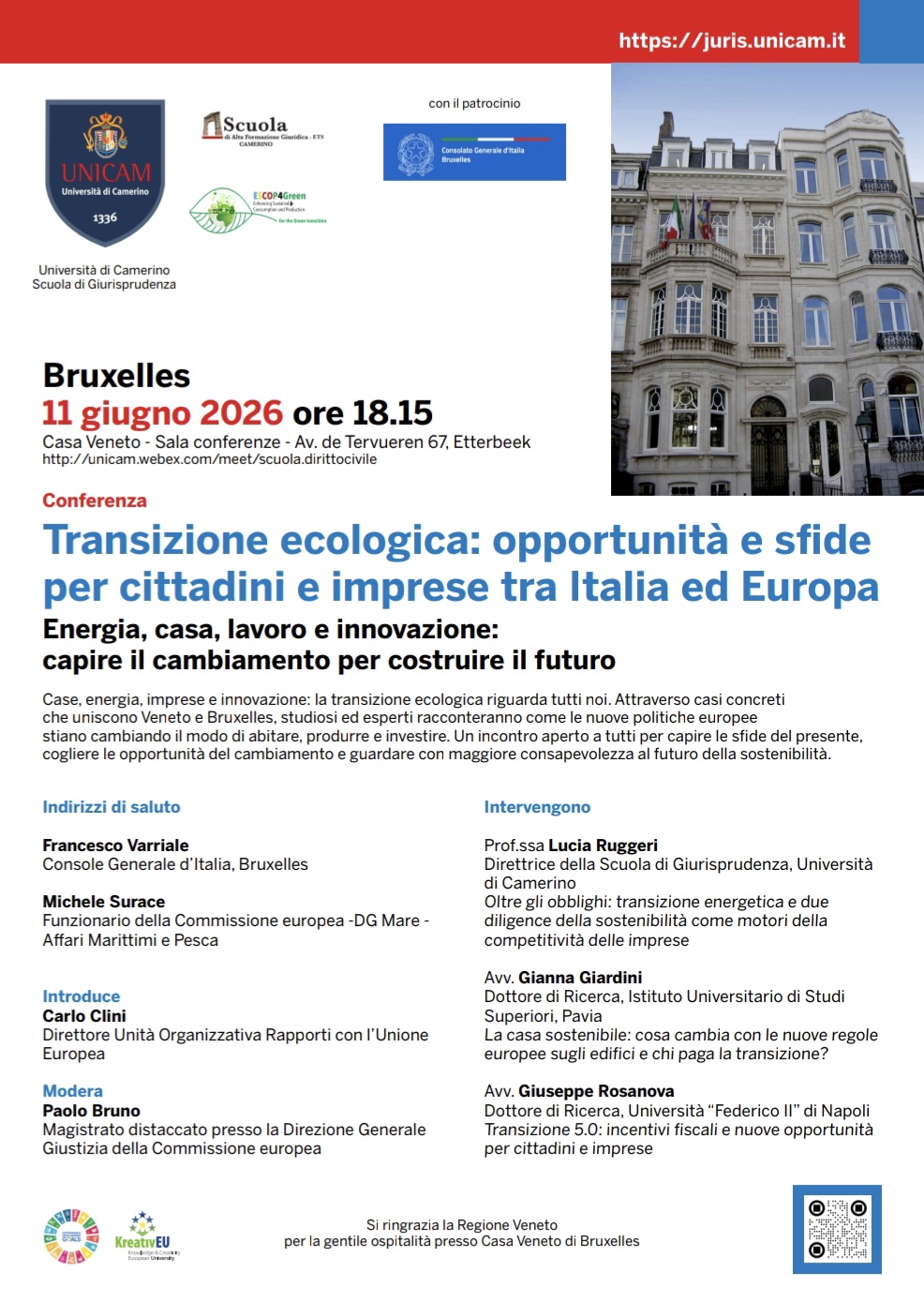
The conference “Transizione ecologica: opportunità e sfide per cittadini e imprese tra Italia ed Europa” was held on 11 June 2026 at Casa Veneto in Brussels, bringing together academics, institutional representatives, legal experts, and policymakers to discuss the impact of the green transition on energy, housing, employment, innovation, and business development.

Organized by the University of Camerino’s School of Law, with the patronage of the Consulate General of Italy in Brussels and within the framework of the ESCOP4Green Project, the event explored how European policies are reshaping the ways citizens live, work, invest, and consume energy. Through practical examples connecting local and European experiences, participants examined both the opportunities and the challenges arising from the transition towards a more sustainable economy.

The conference opened with welcome addresses by Francesco Varriale, Consul General of Italy in Brussels, and Michele Surace, Officer at the European Commission’s Directorate-General for Maritime Affairs and Fisheries (DG MARE). The introductory remarks were delivered by Carlo Clini, Director of the Organizational Unit for Relations with the European Union, while the discussion was moderated by Paolo Bruno, Seconded National Expert at the Directorate-General for Justice of the European Commission.

The panel of speakers included Professor Lucia Ruggeri, Director of the School of Law at the University of Camerino, who examined how energy transition obligations and the sustainability due diligence requirements are becoming key drivers of business competitiveness. Dr. Gianna Giardini, PhD researcher at the IUSS School for Advanced Studies in Pavia, addressed the implications of the new European rules on sustainable housing, focusing on their impact on buildings, homeowners, and the distribution of renovation costs. Dr. Giuseppe Rosanova, PhD researcher at the University of Naples Federico II, discussed the concept of “Transition 5.0”, highlighting the role of fiscal incentives and new opportunities for citizens and businesses in supporting sustainable innovation.

By fostering dialogue between academia, institutions, and practitioners, the conference contributed to a deeper understanding of the legal, economic, and social dimensions of the ecological transition, encouraging greater awareness of the pathways toward a more sustainable European future.


Research and Policy Dialogue on Housing Affordability and Energy-Efficient Renovations

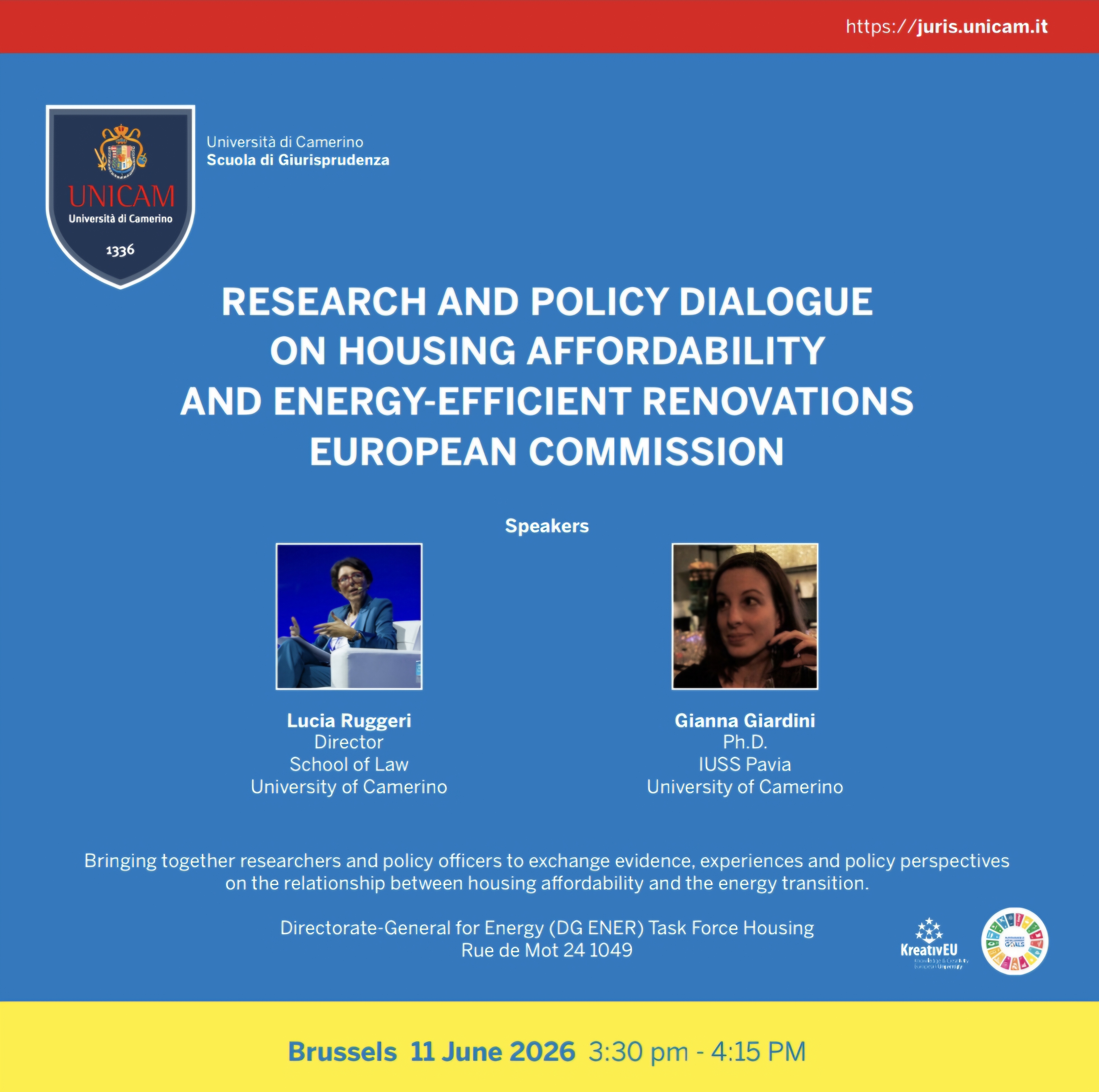
The event “Research and Policy Dialogue on Housing Affordability and Energy-Efficient Renovations”, held on 11 June 2026 at the European Commission in Brussels, brought together researchers and policy experts to discuss the relationship between housing affordability and the energy transition. 

Organized in collaboration with the Directorate-General for Energy (DG ENER) Task Force Housing, the initiative provided a platform for exchanging evidence, experiences, and policy perspectives on how energy-efficient renovations can contribute to more sustainable and affordable housing across Europe.

The dialogue explored the legal, social, and economic dimensions of housing policies in the context of the European Green Deal and the ongoing transition towards a low-carbon economy. 

Particular attention was devoted to the challenges and opportunities arising from the implementation of energy-efficiency measures, with a focus on balancing environmental objectives and social inclusion.

The event featured contributions from Professor Lucia Ruggeri, Director of the School of Law at the University of Camerino, and Dr. Gianna Giardini, Ph.D. researcher at IUSS Pavia and the University of Camerino. Through their presentations and discussion, the speakers highlighted the importance of interdisciplinary research and evidence-based policymaking in addressing housing affordability while advancing Europe’s sustainability goals.

By fostering dialogue between academia and public institutions, the event contributed to the broader debate on developing innovative and socially responsible policies capable of supporting both the energy transition and citizens’ access to affordable housing.

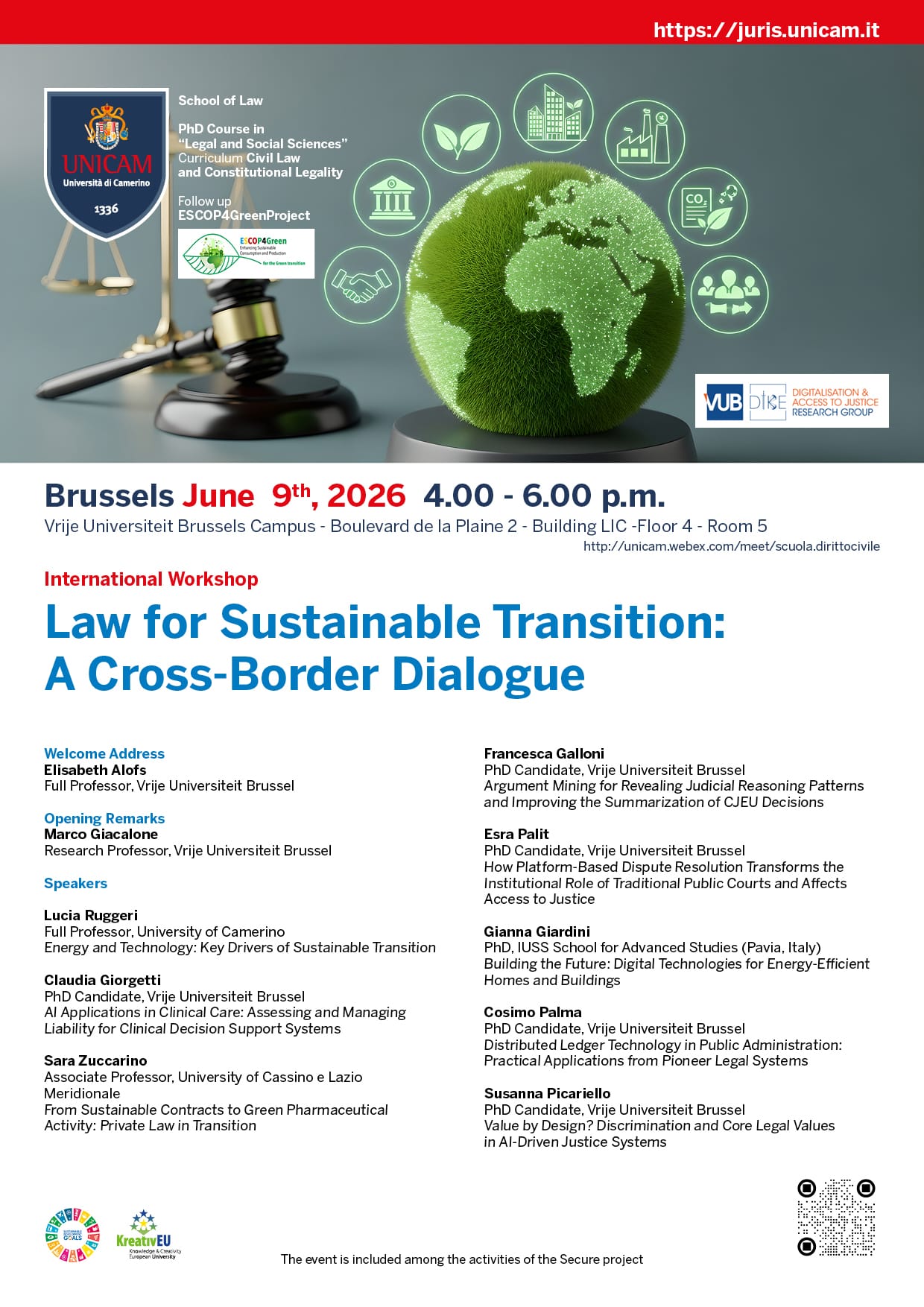
Law for Sustainable Transition: A Cross-Border Dialogue

The international workshop “Law for Sustainable Transition: A Cross-Border Dialogue” took place on 9 June 2026 at the Vrije Universiteit Brussel (VUB), Brussels, bringing together academics and researchers from different countries and disciplines to explore the legal, technological, and social dimensions of sustainable transition.

Organized within the framework of the ESCOP4Green Project and hosted by the Vrije Universiteit Brussel, the event aims to foster interdisciplinary dialogue on the role of law, innovation, and digital technologies in addressing contemporary sustainability challenges. 

Topics include energy transition, artificial intelligence, access to justice, healthcare technologies, sustainable contracts, digitalization, and public administration.

The workshop opened with a welcome address by Elisabeth Alofs, Full Professor at Vrije Universiteit Brussel, followed by opening remarks from Marco Giacalone, Research Professor at Vrije Universiteit Brussel.

The speakers are Lucia Ruggeri (University of Camerino), who discuss energy and technology as key drivers of sustainable transition; Claudia Giorgetti (Vrije Universiteit Brussel), presenting on AI applications in clinical care and clinical decision-support systems; Sara Zuccarino (University of Cassino and Lazio Meridionale), examining the evolution from sustainable contracts to green pharmaceutical activity; Francesca Galloni (Vrije Universiteit Brussel), focusing on argument mining and the summarization of Court of Justice of the European Union decisions; Esra Palit (Vrije Universiteit Brussel), addressing platform-based dispute resolution and access to justice; Gianna Giardini (IUSS School for Advanced Studies, Pavia), exploring digital technologies for energy-efficient homes and buildings; Cosimo Palma (Vrije Universiteit Brussel), discussing distributed ledger technology in public administration; and Susanna Picariello (Vrije Universiteit Brussel), presenting research on value-sensitive design, discrimination, and core legal values in AI-driven justice systems.

By bringing together experts from law, technology, and sustainability studies, the workshop seeks to promote international cooperation and contribute to the development of innovative legal and policy solutions for a sustainable and digitally enabled future.


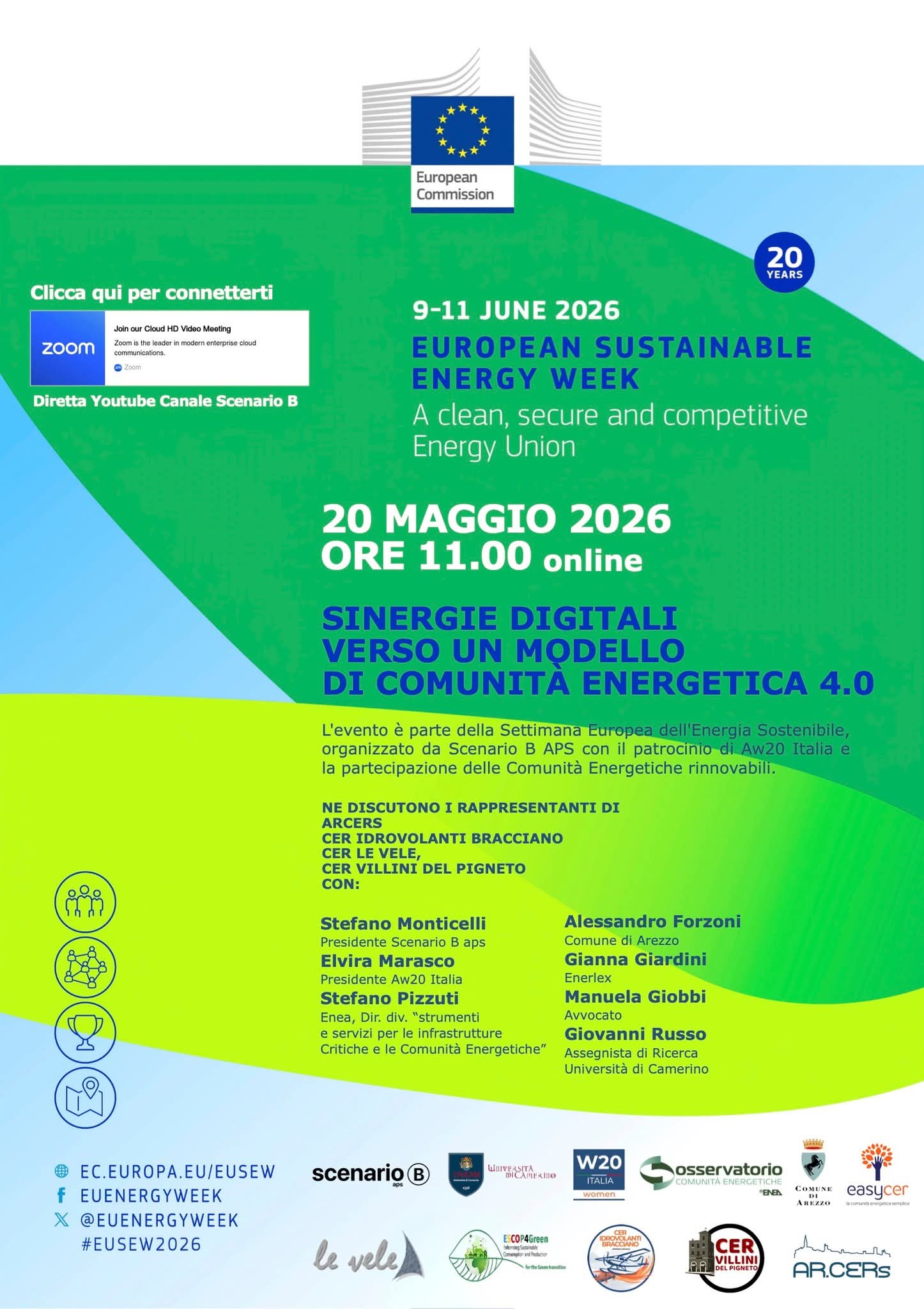
SINERGIE DIGITALI VERSO UN MODELLO DI COMUNITA' ENERGETICA 4.0

L’evento “Sinergie digitali verso un modello di Comunità Energetica 4.0”, pensato dall'assegnista di ricerca dell'Università di camerino, dott. Giovanni Russo, in programma il 20 maggio 2026 alle ore 11.00 in modalità online, si inserisce nel calendario della European Sustainable Energy Week (EUSEW) 2026, la principale iniziativa europea dedicata alla promozione dell’energia sostenibile e della transizione energetica.

Organizzato da Scenario B APS con il patrocinio di AW20 Italia e la partecipazione di diverse Comunità Energetiche Rinnovabili, l’incontro intende approfondire il ruolo delle tecnologie digitali e dell’innovazione nella gestione e nello sviluppo delle comunità energetiche del futuro. 

Attraverso il confronto tra rappresentanti istituzionali, esperti del settore energetico, professionisti e realtà territoriali, sono state analizzate esperienze concrete, modelli organizzativi e opportunità offerte dalla digitalizzazione per favorire la produzione, la condivisione e il consumo sostenibile dell’energia.

Nel corso dell’evento sono intervenuti i rappresentanti di ARCERS, CER Idrovolanti Bracciano, CER Le Vele e CER Villini del Pigneto. 

Tra i relatori figurano: Stefano Monticelli, Presidente di Scenario B APS; Elvira Marasco, Presidente di AW20 Italia; Stefano Pizzuti, Direttore della Divisione “Strumenti e servizi per le infrastrutture critiche e le comunità energetiche” di ENEA; Alessandro Forzoni, rappresentante del Comune di Arezzo; Gianna Giardini di Enerlex; Manuela Giobbi, avvocato esperta in materia energetica; e Giovanni Russo, assegnista di ricerca presso l’Università di Camerino.

L’iniziativa si propone di favorire il dialogo tra istituzioni, comunità energetiche, mondo della ricerca e professionisti del settore, promuovendo una riflessione sulle prospettive di evoluzione delle Comunità Energetiche Rinnovabili verso modelli sempre più integrati, digitali e partecipativi.


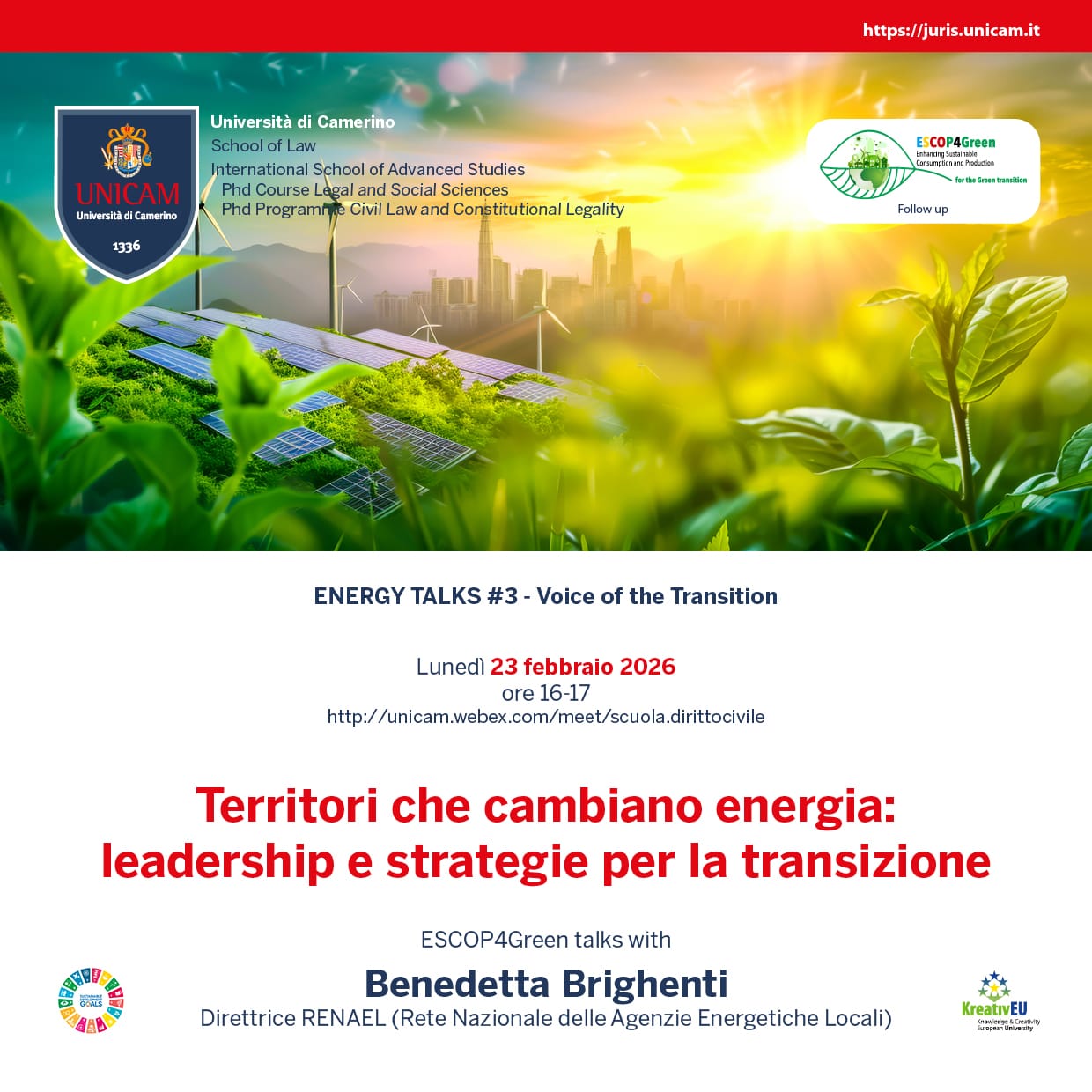
Territori che cambiano energia: leadership e strategie per la transizione

L’evento "Energy Talks #3 – Voice of the Transition" è un seminario online dedicato ai temi della transizione energetica e dello sviluppo sostenibile, organizzato dall’Università di Camerino nell’ambito del progetto ESCOP4Green. 

L’incontro si è tenuto lunedì 23 febbraio 2026, dalle ore 16:00 alle 17:00, in modalità telematica tramite piattaforma Webex.

Il focus dell’appuntamento è stato intitolato “Territori che cambiano energia: leadership e strategie per la transizione”, un tema che approfondisce il ruolo delle amministrazioni locali, delle comunità e delle istituzioni nella promozione di politiche energetiche innovative e sostenibili. 

Ospite dell’incontro è stata la dott.ssa Benedetta Brighenti, Direttrice di RENAEL, che ha condiviso esperienze, strategie e buone pratiche legate alla governance della transizione energetica nei territori.

L’iniziativa si inserisce nel percorso di riflessione promosso dall’Università di Camerino sui temi della sostenibilità ambientale, dell’energia e degli obiettivi dell’Agenda 2030, favorendo il dialogo tra mondo accademico, istituzioni e professionisti del settore.


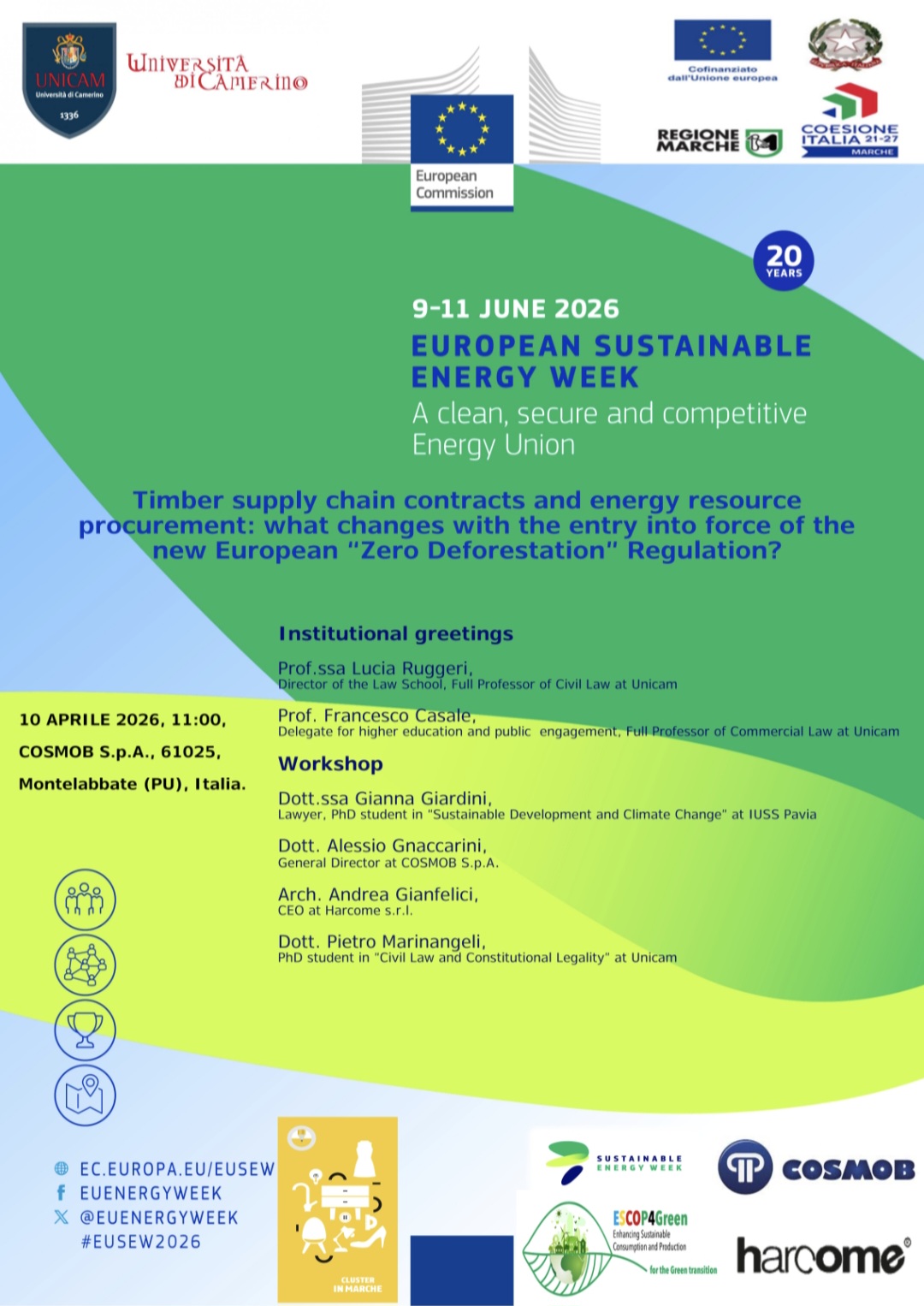
Energy Sustainable day - Timber supply chain contracts and energy resource procurement: what changes with the entry into force of the new European “Zero Deforestation” Regulation?

Within the framework of the European Sustainable Energy Week (EUSEW) 2026, COSMOB S.p.A. hosted a workshop entitled “Timber Supply Chain Contracts and Energy Resource Procurement: What Changes with the Entry into Force of the New European Zero Deforestation Regulation?”, dedicated to examining the effects of the new European Zero Deforestation Regulation and its implications for timber supply chains and energy resource procurement.

The event provided an important opportunity for dialogue among academics, legal professionals, researchers, and industry stakeholders, with the aim of exploring the innovations introduced by the European Zero Deforestation Regulation and their impact on supply chain contracts, raw material traceability processes, and corporate sustainability strategies.

Following the institutional greetings delivered by representatives of the University of Camerino, the workshop featured contributions from legal experts, researchers, and professionals from the industrial and productive sectors, who offered interdisciplinary perspectives on the challenges and opportunities arising from the new European regulatory framework.

The meeting took place on 10 April 2026 at 11:00 a.m. at the headquarters of COSMOB S.p.A. in Montelabbate (Province of Pesaro and Urbino, Italy). The initiative aimed to foster dialogue among academia, institutions, and businesses in order to support the sustainable transition of production supply chains in line with European environmental objectives.

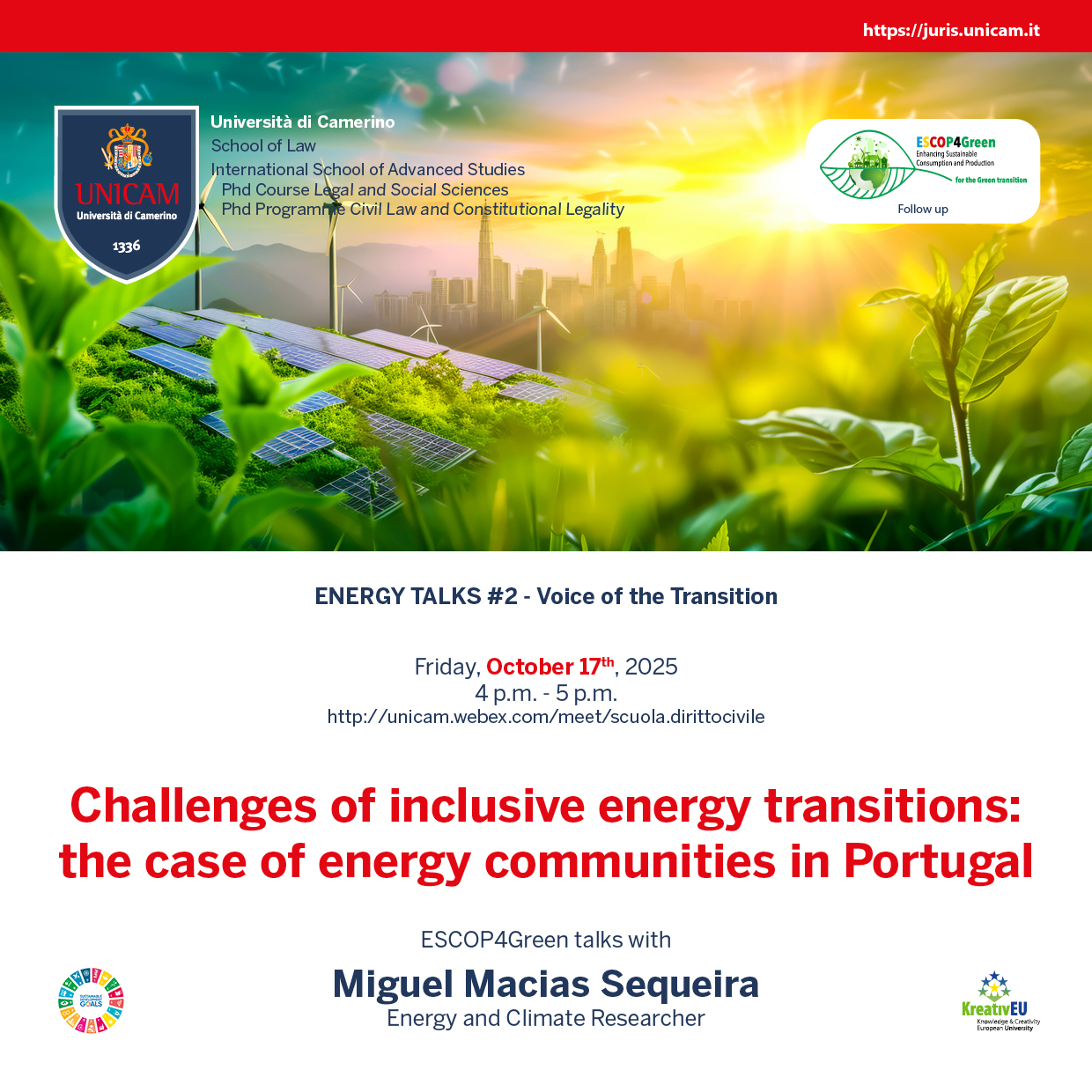
Challenges of inclusive energy transitions: the case of energy communities in Portugal

🌍 ENERGY TALKS #2 – Voice of the Transition ⚡️

The series continues with a new conversation on the challenges and opportunities of the energy transition!

🎙️ This week, we welcome Miguel Macias Sequeira, Energy and Climate Researcher, who will explore the challenges of inclusive energy transitions, focusing on the case of energy communities in Portugal. 🇵🇹

📅 Friday, October 17th, 2025
🕓 4:00 p.m. – 5:00 p.m.
💻 Online via Webex: https://lnkd.in/dQwY77SF
Join the conversation and gain new insights into the future of energy transitions. ⚡️
hashtag#EnergyTalks hashtag#VoiceOfTheTransition hashtag#UNICAM hashtag#ESCOP4Green hashtag#Sustainability

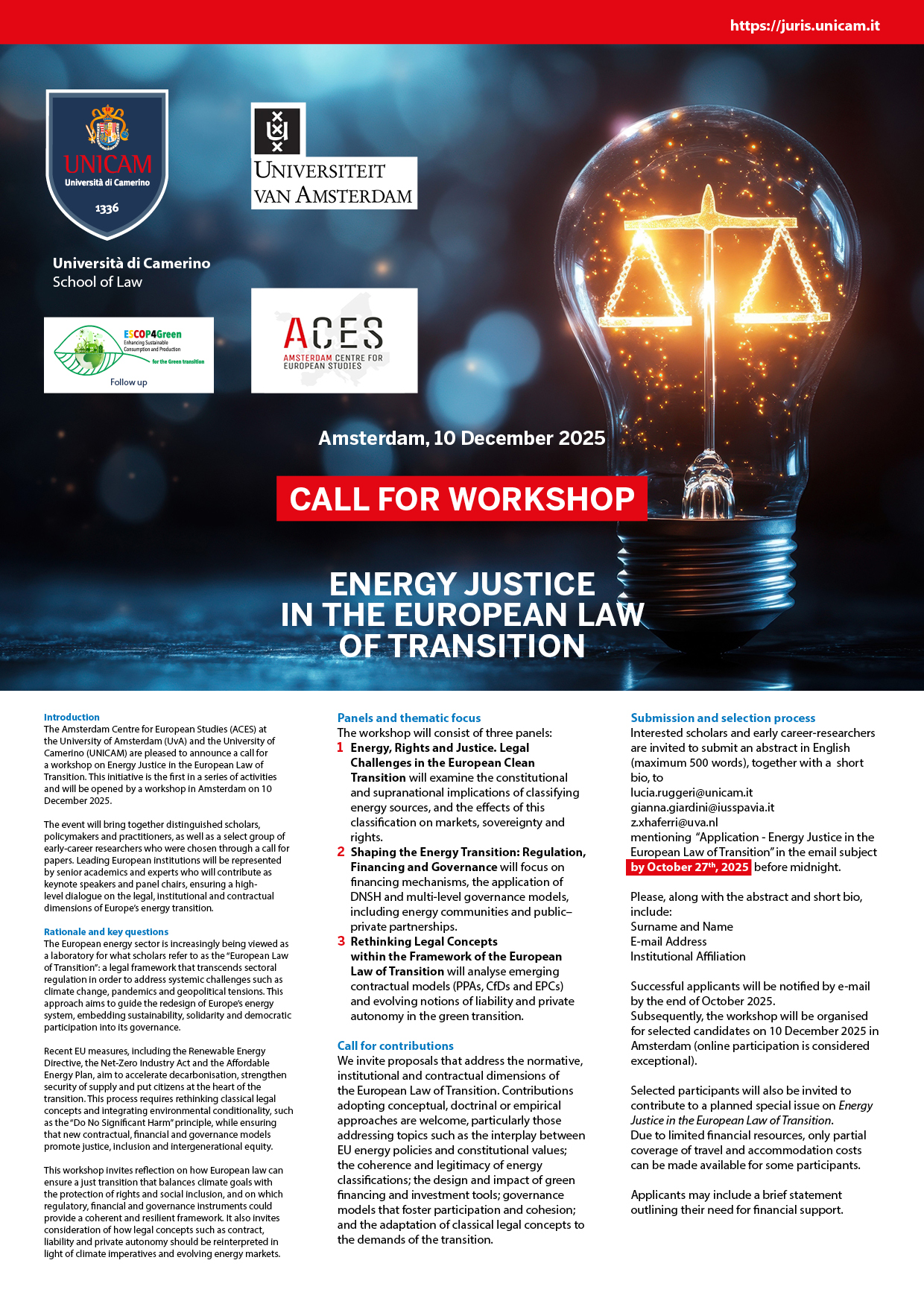
Energy Justice in the European Law of Transition

Workshop – Energy Justice in the European Law of Transition
Amsterdam, 10 dicembre 2025

Il workshop, organizzato dal Centro di Studi Europei dell’Università di Amsterdam (ACES) e dall’Università di Camerino (UNICAM), intende promuovere un confronto interdisciplinare sui profili giuridici della transizione energetica europea, con particolare attenzione ai temi della giustizia energetica, della governance e delle categorie giuridiche da ripensare alla luce delle nuove sfide.

L’iniziativa si rivolge in particolare a giovani ricercatori, invitati a partecipare come speaker attraverso la presentazione di un abstract in inglese (max 500 parole) e di una breve bio entro il 15 ottobre 2025.

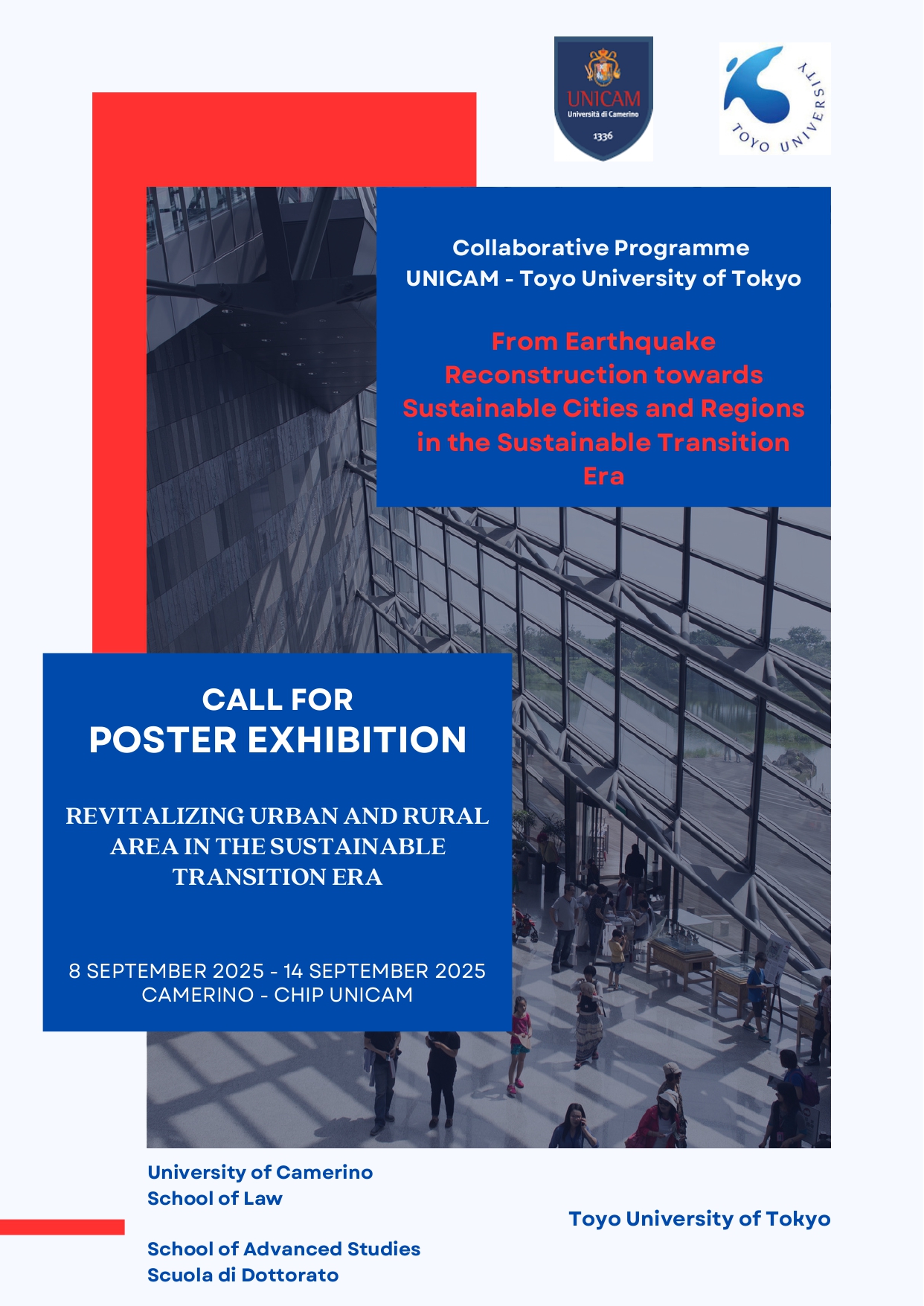
UNICAM_TOYO 2025 Call for Poster Exhibition

From 5 to 10 September, a group of students from Toyo University of Tokyo will return to explore and study earthquake-affected areas, accompanied by several professors from various disciplines. This visit is in line with the collaboration agreement, which was activated immediately after the 2016 earthquake and renewed in 2023.The professors and students, who come from five faculties, will analyse the post-earthquake situation and study revitalisation strategies using a multidisciplinary approach and empirical methodology. 

PhD Candidates and PhD interested in presenting a poster on their research into reconstruction and revitalisation in earthquake-hit areas are welcome to participate. 

The poster must be sent in digital format to Prof.Lucia Ruggeri (lucia.ruggeri@unicam.it) by 4 September 2025. 

The exhibition will take place from 8 September at 9 a.m. to 14 September 2025 in Camerino at the Chip. 

The poster exhibition will open on 8 September 2025 at 9 a.m. at the Chip.