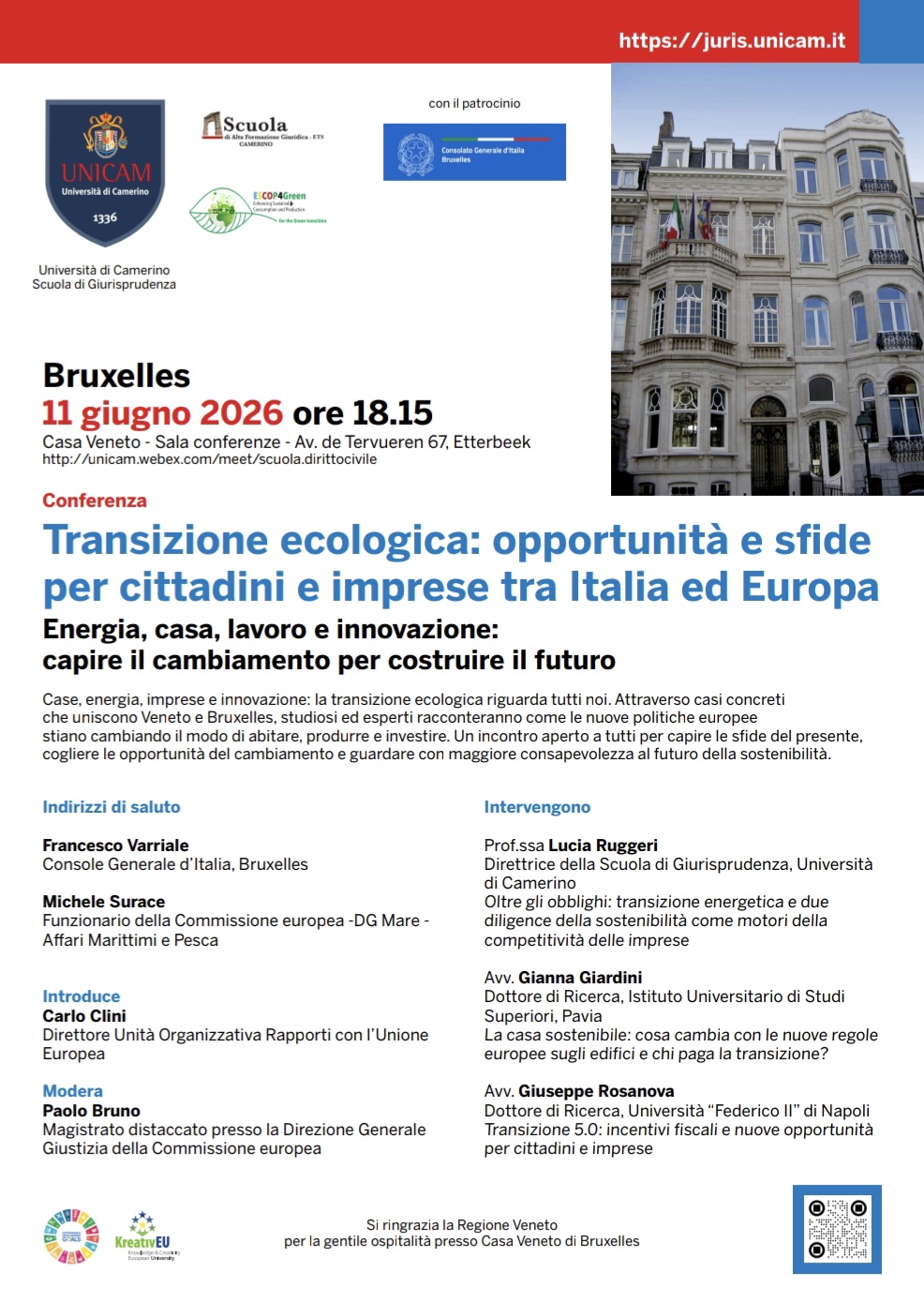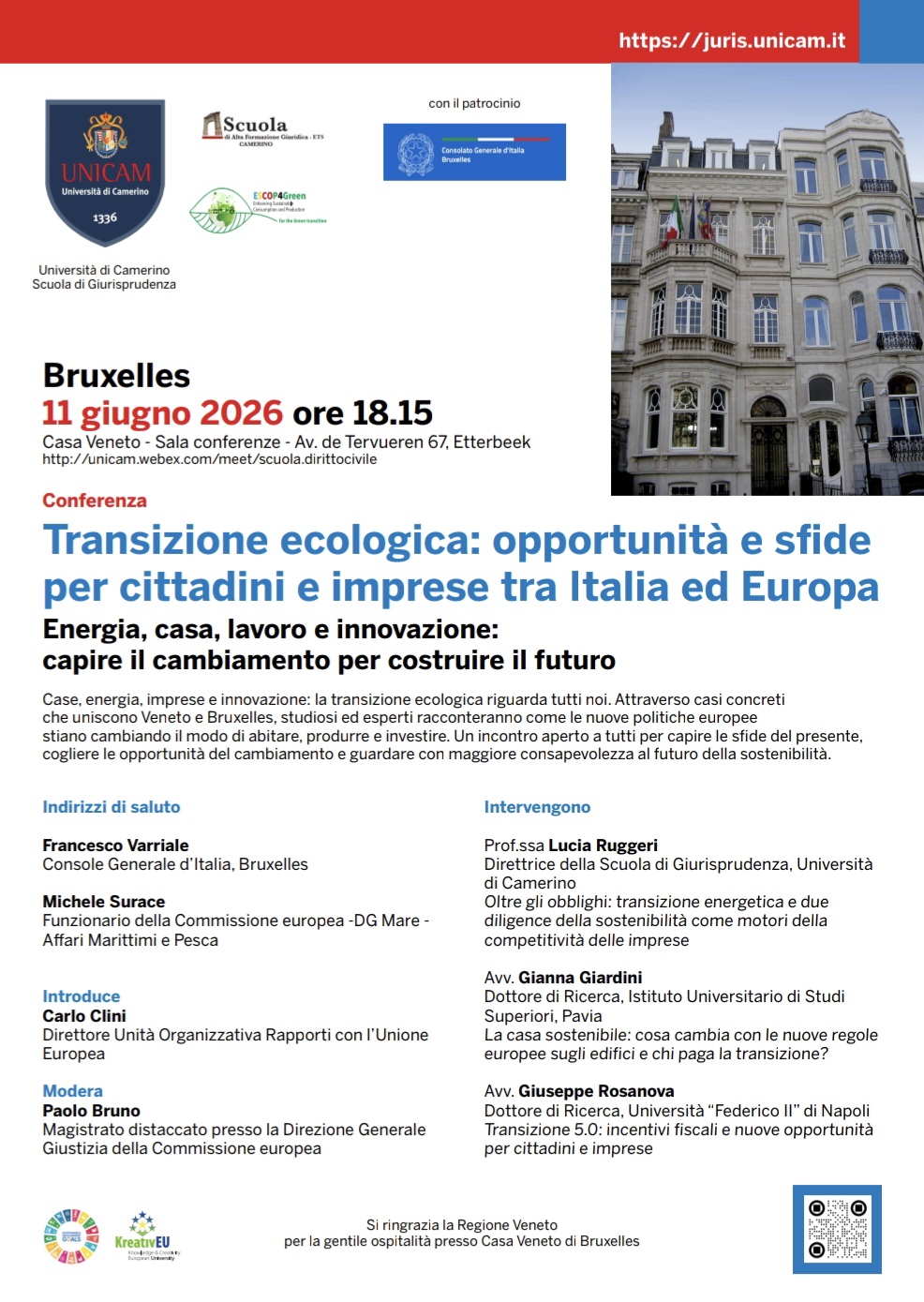


The conference “Transizione ecologica: opportunità e sfide per cittadini e imprese tra Italia ed Europa” was held on 11 June 2026 at Casa Veneto in Brussels, bringing together academics, institutional representatives, legal experts, and policymakers to discuss the impact of the green transition on energy, housing, employment, innovation, and business development.
Organized by the University of Camerino’s School of Law, with the patronage of the Consulate General of Italy in Brussels and within the framework of the ESCOP4Green Project, the event explored how European policies are reshaping the ways citizens live, work, invest, and consume energy. Through practical examples connecting local and European experiences, participants examined both the opportunities and the challenges arising from the transition towards a more sustainable economy.
The conference opened with welcome addresses by Francesco Varriale, Consul General of Italy in Brussels, and Michele Surace, Officer at the European Commission’s Directorate-General for Maritime Affairs and Fisheries (DG MARE). The introductory remarks were delivered by Carlo Clini, Director of the Organizational Unit for Relations with the European Union, while the discussion was moderated by Paolo Bruno, Seconded National Expert at the Directorate-General for Justice of the European Commission.
The panel of speakers included Professor Lucia Ruggeri, Director of the School of Law at the University of Camerino, who examined how energy transition obligations and the sustainability due diligence requirements are becoming key drivers of business competitiveness. Dr. Gianna Giardini, PhD researcher at the IUSS School for Advanced Studies in Pavia, addressed the implications of the new European rules on sustainable housing, focusing on their impact on buildings, homeowners, and the distribution of renovation costs. Dr. Giuseppe Rosanova, PhD researcher at the University of Naples Federico II, discussed the concept of “Transition 5.0”, highlighting the role of fiscal incentives and new opportunities for citizens and businesses in supporting sustainable innovation.
By fostering dialogue between academia, institutions, and practitioners, the conference contributed to a deeper understanding of the legal, economic, and social dimensions of the ecological transition, encouraging greater awareness of the pathways toward a more sustainable European future.