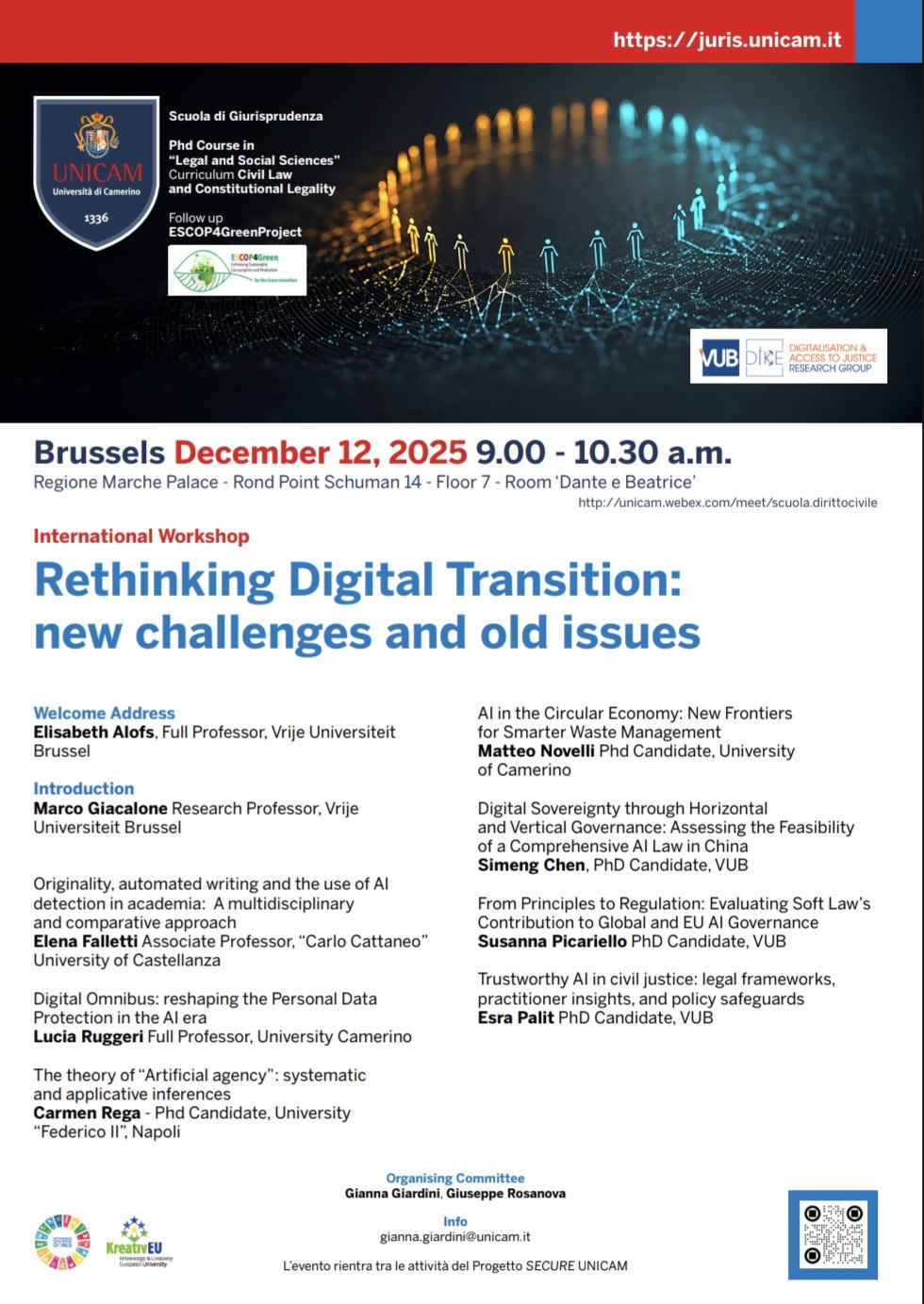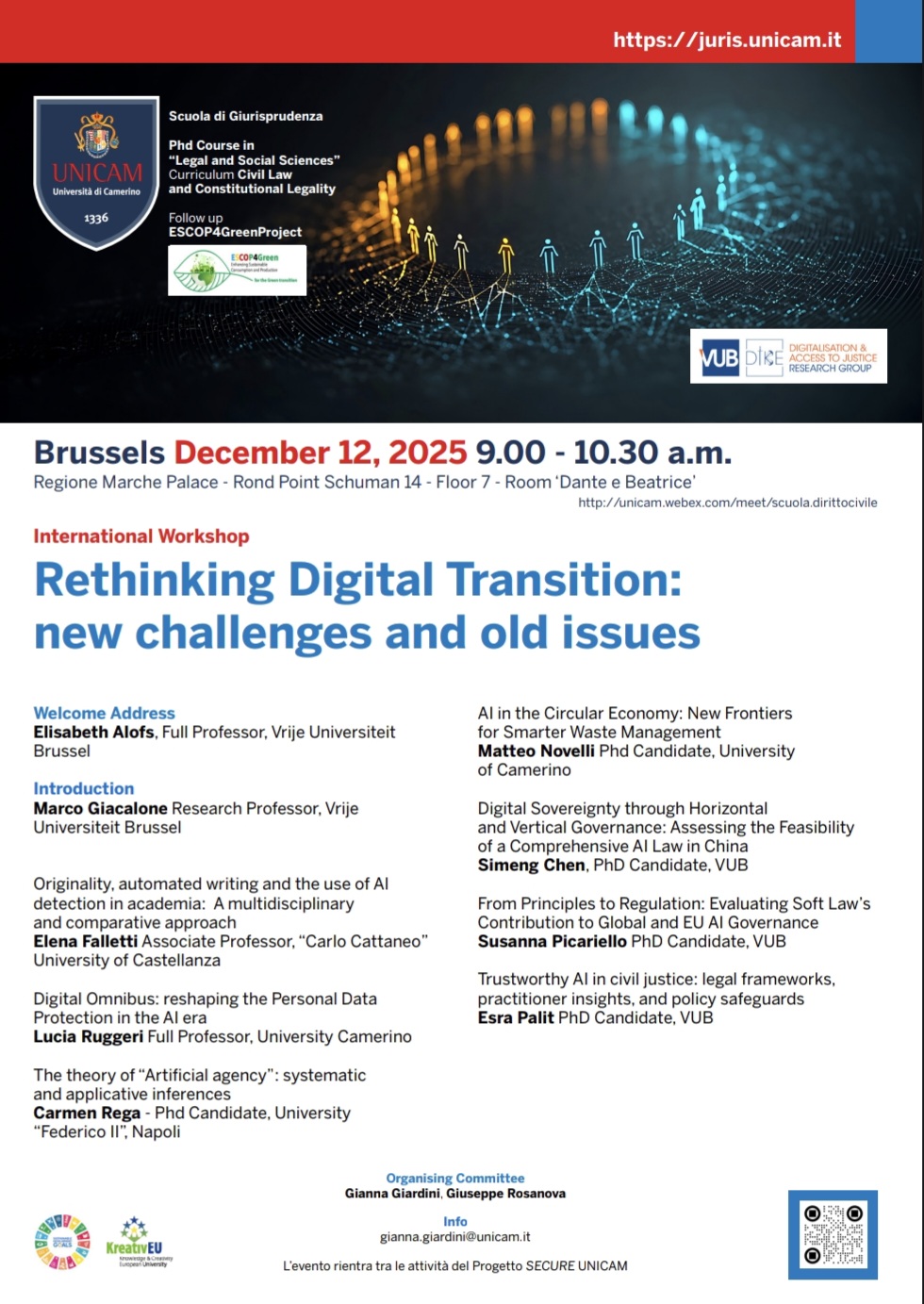


The international workshop “Rethinking Digital Transition: New Challenges and Old Issues”, held on 12 December 2025 at the Regione Marche Palace in Brussels, brought together academics, researchers, and legal scholars to examine the evolving relationship between digital transformation, artificial intelligence, governance, and fundamental rights.
Organized within the activities of the SECURE Project and in collaboration with the Digitalisation & Access to Justice Research Group of Vrije Universiteit Brussel (VUB), the workshop provided an interdisciplinary forum for discussing both emerging opportunities and longstanding challenges arising from the digital transition.
The event opened with a welcome address by Elisabeth Alofs, Full Professor at Vrije Universiteit Brussel, followed by introductory remarks from Marco Giacalone, Research Professor at VUB.
The discussions explored a wide range of topics related to artificial intelligence, digital governance, data protection, academic integrity, access to justice, and sustainability.
Among the speakers, Elena Falletti (Carlo Cattaneo University of Castellanza) examined originality, automated writing, and the use of AI-detection tools in academia from a multidisciplinary and comparative perspective.
Lucia Ruggeri (University of Camerino) discussed the implications of the Digital Omnibus framework for personal data protection in the age of artificial intelligence.
Carmen Rega (University of Naples Federico II) presented research on the theory of “artificial agency” and its systematic and practical applications.
Matteo Novelli (University of Camerino) explored the role of artificial intelligence in the circular economy, focusing on innovative approaches to smarter waste management.
Simeng Chen (Vrije Universiteit Brussel) analyzed issues of digital sovereignty and AI governance, with particular attention to the feasibility of a comprehensive AI legal framework in China.
Susanna Picariello (Vrije Universiteit Brussel) examined the contribution of soft law instruments to global and European Union AI governance, while Esra Palit (Vrije Universiteit Brussel) addressed the development of trustworthy AI in civil justice, highlighting legal frameworks, practical challenges, and policy safeguards.
By fostering dialogue among experts from different legal and technological backgrounds, the workshop contributed to a deeper understanding of the opportunities and risks associated with digital transformation, emphasizing the need for balanced regulatory approaches capable of promoting innovation while safeguarding fundamental rights and democratic values.